Design, Development and Assessment of a 3D Printed Pediatric Flexible Bronchoscopy Simulator
Article Sidebar
Main Article Content
Abstract
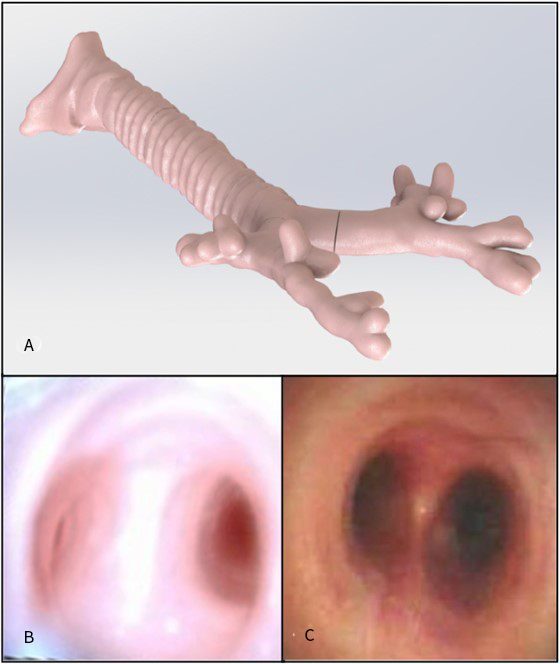
Pediatric flexible bronchoscopy is a potentially risky procedure that requires realistic training for optimal procedural yield and complication mitigation. Three-dimensional printing represents a promising technology for developing realistic and low-cost surgical training models, but its utility in pediatric flexible bronchoscopy has not been thoroughly explored. A 3D-printed training simulator was developed by computer-aided design including: (1) a synthetic pediatric airway down to the 3rd generation and a distal reservoir to simulate bronchoalveolar lavage and (2) the benchtop enclosure including a mechanical airway and external pegs for simulation of extraluminal airway compression. Using stereolithography, the airway was fabricated with an elastic resin. An external surface finish was applied using silicone-based fabric paint and biocompatible adhesive to match physiologic intraluminal color. The benchtop enclosure was manufactured using polylactic acid via fused deposition modeling. The 3D-printed airway simulator was evaluated alongside a traditional virtual reality bronchoscopy simulator across 6 domains: physical attributes, realism of experience, ability to perform tasks, educational value, relevance to clinical practice, and global assessment. Six fellowship trainees rated the 3D printed airway favorably across all domains and assessments were similar to the traditional virtual reality simulator. The 3D printed airway had a fixed unit material cost of $6.09 for the airway and $17.13 for the benchtop enclosure. This preliminary assessment of a 3D printed pediatric flexible bronchoscopy simulator suggests that it provides a realistic, customizable and cost-effective mechanism for advanced training in pediatric flexible bronchoscopy.
Downloads
Article Details

This work is licensed under a Creative Commons Attribution 4.0 International License.
Share
References
1. Leong A, Benscoter D, Brewington J, Torres-Silva C, Wood RE. Pediatric flexible airway endoscopy training during a pandemic and beyond: Bending the curve. Pediatr Pulmonol. 2021 Feb;56(6):1386–8. doi: 10.1002/ppul.25311.
2. Leong AB, Green CG, Kurland G, Wood RE. A survey of training in pediatric flexible bronchoscopy. Pediatr Pulmonol. 2014 Jun;49(6):605–10. doi: 10.1002/ppul.22872.
3. Corbetta L, Arru LB, Mereu C, Pasini V, Patelli M. Competence and training in interventional pulmonology. Panminerva Med. 2019;61(3):203–31. doi: 10.23736/S0031-0808.18.03562-0.
4. Ram B, Oluwole M, Blair RL, Mountain R, Dunkley P, White PS. Surgical simulation: an animal tissue model for training in therapeutic and diagnostic bronchoscopy. J Laryngol Otol. 1999 Feb;113(2):149–51. doi: 10.1017/s0022215100143415.
5. Colt HG, Crawford SW, Galbraith O, 3rd. Virtual reality bronchoscopy simulation: a revolution in procedural training. Chest. 2001 Oct;120(4):1333–9. doi: 10.1378/chest.120.4.1333.
6. Andersen AG, Rahmoui L, Dalsgaard TS, Svendsen MBS, Clementsen PF, Konge L, et al. Preparing for Reality: A Randomized Trial on Immersive Virtual Reality for Bronchoscopy Training. Respiration. 2023 Apr;102(4):316–23. doi: 10.1159/000528319.
7. Grab M, Hopfner C, Gesenhues A, Konig F, Haas NA, Hagl C, et al. Development and Evaluation of 3D-Printed Cardiovascular Phantoms for Interventional Planning and Training. J Vis Exp. 2021 Jan;(167):e62063. doi: 10.3791/62063.
8. Powell AR, Srinivasan S, Green G, Kim J, Zopf DA. Computer-aided design, 3-D-printed manufacturing, and expert validation of a high-fidelity facial flap surgical simulator. JAMA Facial Plast Surg. 2019 Jul;21(4):327–31. doi: 10.1001/jamafacial.2019.0050.
9. Chang B, Powell A, Ellsperman S, Wehrmann D, Landry A, Jabbour N, et al. Multicenter advanced pediatric otolaryngology fellowship prep surgical simulation sourse with 3D printed high-fidelity models. Otolaryngol Head Neck Surg. 2020 May;162(5):658–65. doi: 10.1177/0194599820913003.
10. Michaels RE, Zugris NV, Cin MD, Monovoukas DA, Koka KK, Smith C, et al. A national pediatric otolaryngology fellowship virtual dissection course using 3D printed simulators. Int J Pediatr Otorhinolaryngol. 2022 Nov;162:111273. doi: 10.1016/j.ijporl.2022.111273.
11. Ha JF, Morrison RJ, Green GE, Zopf DA. Computer-aided design and 3-dimensional printing for costal cartilage simulation of airway graft carving. Otolaryngol Head Neck Surg. 2017 Jun;156(6):1044–7. doi: 10.1177/0194599817697048.
12. Ho BHK, Chen CJ, Tan GJS, Yeong WY, Tan HKJ, Lim AYH, et al. Multi-material three dimensional printed models for simulation of bronchoscopy. BMC Med Educ. 2019 Jun;19(1):236. doi: 10.1186/s12909-019-1677-9.
13. Pedersen TH, Gysin J, Wegmann A, Osswald M, Ott SR, Theiler L, et al. A randomised, controlled trial evaluating a low cost, 3D-printed bronchoscopy simulator. Anaesthesia. 2017 Aug;72(8):1005–9. doi: 10.1111/anae.13951.
14. Hornung A, Kumpf M, Baden W, Tsiflikas I, Hofbeck M, Sieverding L. Realistic 3D-printed tracheobronchial tree model from a 1-Year-Old Girl for Pediatric Bronchoscopy Training. Respiration. 2017 Mar;93(4):293–5. doi: 10.1159/000459631.
15. Painter N, Monovoukas D, Delecaris AO, Coverstone AM, Zopf DA, Saba TG. Incorporating a three-dimensional printed airway into a pediatric flexible bronchoscopy curriculum. ATS Sch. 2024 Mar;5(1):142–53. doi: 10.34197/ats-scholar.2023-0078OC.
16. Barsness KA, Rooney DM, Davis LM. Collaboration in simulation: the development and initial validation of a novel thoracoscopic neonatal simulator. J Pediatr Surg. 2013 Jun;48(6):1232–8. doi: 10.1016/j.jpedsurg.2013.03.015.
17. Witsberger CA, Michaels R, Monovoukas D, Cin M, Zugris NV, Nourmohammadi Z, et al. Development of a high-fidelity, 3D printed otoplasty surgical simulator. Ann Otol Rhinol Laryngol. 2023 Jun;132(6):607–13. doi: 10.1177/00034894221105831.
18. Artino AR, Jr., La Rochelle JS, Dezee KJ, Gehlbach H. Developing questionnaires for educational research: AMEE Guide No. 87. Med Teach. 2014 Jun;36(6):463–74. doi: 10.3109/0142159X.2014.889814.